Books
Georg Wilhelm Friedrich Hegel

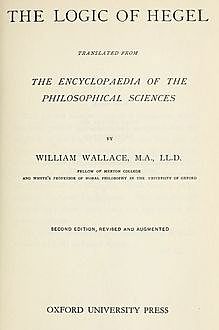
Hegel: The Science of Logic

Georg Wilhelm Friedrich Hegel's “Science of Logic” stands as a monumental work in the realm of philosophy, intricately exploring the nature and development of thought itself. Employing a dialectical method, Hegel meticulously constructs a framework where concepts evolve through contradictions, ultimately revealing a profound interconnectivity in human reasoning. His literary style is characterized by dense, systematic exposition and a commitment to uncovering the underlying structures of ideas, positioning this text as a cornerstone of German Idealism and a precursor to later existential thought. Hegel, an influential figure born in 1770, was immersed in the intellectual currents of his time, including Kantian philosophy and the tumultuous socio-political landscape of post-revolutionary Europe. His experiences as a student and teacher, coupled with his engagement in the philosophical debates of his era, significantly shaped his thought processes. Through “Science of Logic,” Hegel aimed to elucidate the mechanistic progression of logical categories, providing a rigorous foundation for subsequent philosophical inquiry and laying the groundwork for metaphysical exploration. This distinguished text is highly recommended for readers seeking to grasp the intricacies of Hegelian philosophy. It invites scholars, students, and philosophy enthusiasts alike to engage with the dialectical method, enhancing their understanding of not only logic but also the nature of philosophical inquiry itself.
539 printed pages
Copyright owner
Bookwire
Original publication
2023
Publication year
2023
Publisher
Good Press
Translator
William Wallace
Have you already read it? How did you like it?
👍👎

Quotes

  • Liana Lutfullinahas quotedlast year
    Man,—and that just because it is his nature to think,—is the only being that possesses law, religion, and morality.
  • Liana Lutfullinahas quotedlast year
    strictly human and thought-induced phenomena of consciousness do not originally appear in the form of a thought, but as a feeling, a perception, or mental image
  • Liana Lutfullinahas quotedlast year
    Philosophy, on the other hand, is a peculiar mode of thinking—a mode in which thinking becomes knowledge, and knowledge through notions
fb2epub
Drag & drop your files (not more than 5 at once)